In this article
- What Does the ACL Do?
- Partial ACL Tear vs Complete ACL Tear: The Key Differences
- Common ACL Tear Symptoms
- How Is the Type of ACL Tear Diagnosed?
- Can a Partial ACL Tear Heal Without Surgery?
- When Does a Partial ACL Tear Need Surgery?
- Does Every Complete ACL Tear Need Surgery?
- What Happens If You Ignore an ACL Tear?
- What Does ACL Surgery Involve?
- Surgery or No Surgery? A Simple Decision Guide
- Frequently Asked Questions
- Meet Dr. Aditya Jain: Your ACL and Sports Injury Specialist
A twisting landing during a football match, a sudden pivot on the badminton court, or a bad step while running — and then a loud “pop” in the knee, followed by swelling and a feeling that the joint will give way. If this sounds familiar, you may have injured your anterior cruciate ligament (ACL). The first question almost every patient asks is: “Do I need surgery?”
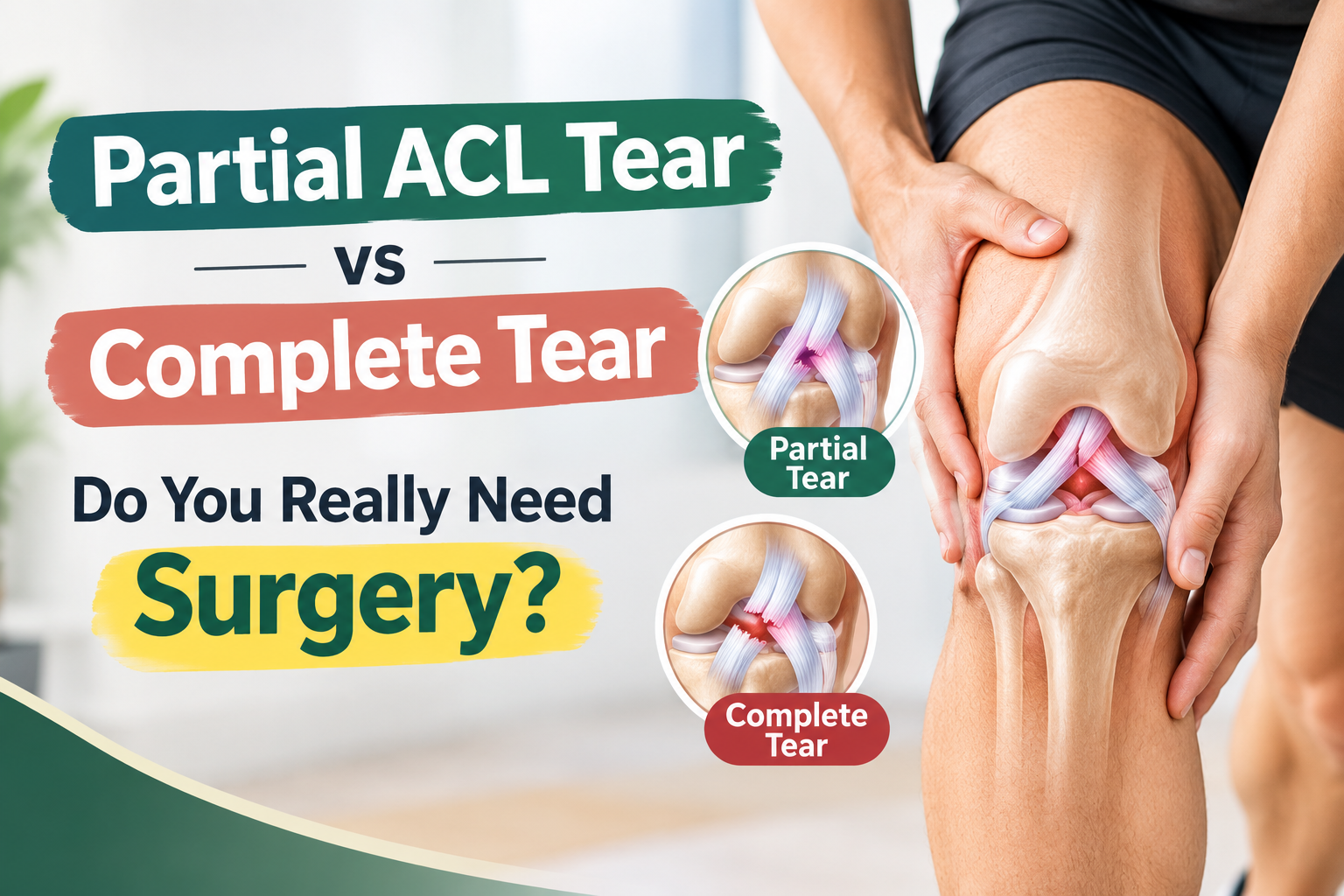
The honest answer is: it depends. A partial ACL tear and a complete ACL tear are very different injuries, and the right treatment depends on how much of the ligament is torn, how unstable your knee feels, your age, and how active you want to be. In this guide, we explain the difference in simple language and help you understand when surgery is truly necessary and when it can be safely avoided.
What Does the ACL Do?
The ACL is a strong band of tissue in the centre of the knee that connects the thigh bone (femur) to the shin bone (tibia). Its main job is to stop the shin bone from sliding forward and to control rotation of the knee during pivoting, jumping and sudden changes in direction. When it is injured, the knee can feel loose, unreliable and painful, especially during sport.
Partial ACL Tear vs Complete ACL Tear: The Key Differences
| Feature | Partial ACL Tear | Complete ACL Tear |
|---|---|---|
| What is torn | Some fibres of the ligament are torn; the rest still holds the knee | The ligament is torn fully into two pieces |
| Knee stability | Often mild to moderate looseness; may feel fairly stable in daily life | Frequent “giving way”, especially while twisting or pivoting |
| Swelling & pain | Present, but usually settles faster | Marked swelling within hours of injury |
| Can it heal on its own? | Partly; the intact fibres may carry the load with good rehab | No; a fully torn ACL does not reconnect by itself |
| Usual first-line treatment | Physiotherapy-led, non-surgical care | Depends on age, activity level and instability |
| Surgery needed? | Only in selected cases | Often advised for active patients; not always for everyone |
Research shows that partial tears account for roughly 10% to 28% of isolated ACL injuries, and they can be hard to diagnose because the knee may not feel obviously unstable. Some partial tears can also progress to complete tears over time, particularly if you keep returning to pivoting sports without proper rehabilitation.
Common ACL Tear Symptoms
- A “pop” sound or sensation at the time of injury
- Rapid swelling of the knee, usually within a few hours
- Pain on the outer or central part of the knee
- A feeling that the knee is “giving way” or buckling
- Difficulty fully straightening or bending the knee
- Trouble trusting the knee during turning, jumping or stair descent
Symptoms alone cannot tell a partial tear from a complete one. A proper clinical examination and an MRI scan are needed to know exactly what has happened inside your knee, including whether the meniscus or other ligaments are also injured.
How Is the Type of ACL Tear Diagnosed?
An orthopaedic specialist will first examine your knee using stability tests such as the Lachman test and the pivot-shift test, which show how much your shin bone moves compared with your healthy knee. An MRI then shows the ligament, the meniscus and the cartilage in detail. In some cases, a diagnostic knee arthroscopy (a keyhole camera procedure) helps confirm how much of the ACL is actually intact.
Can a Partial ACL Tear Heal Without Surgery?
Many patients with a partial ACL tear do well without surgery, especially when the knee is stable on examination. Treatment usually includes:
- Rest and protection in the early phase, with a knee brace if advised
- Ice, compression and elevation to control swelling
- Structured physiotherapy to restore movement, then build thigh (quadriceps and hamstring), hip and core strength
- Balance and proprioception training so the knee reacts better during movement
- Activity modification, such as avoiding sudden pivoting sports for a period
It is important to understand that “non-surgical” does not mean “do nothing.” Good outcomes depend on disciplined rehabilitation and regular follow-up. Studies also suggest that around half of patients return to their pre-injury level of sport after a partial tear, mostly when they limit high-demand activities, so expectations need to be realistic.
When Does a Partial ACL Tear Need Surgery?
Surgery may be considered for a partial ACL tear if:
- The knee continues to give way despite 3 to 6 months of proper physiotherapy
- You are a young athlete who wants to return to football, cricket, badminton, basketball or other pivoting sports
- The tear involves a key bundle of the ligament causing rotational instability
- There is an associated meniscus tear or cartilage injury that needs repair
- Repeated episodes of instability are damaging the knee
Does Every Complete ACL Tear Need Surgery?
Not necessarily. Because a completely torn ACL cannot heal on its own, surgery is commonly recommended for people who are young, active or involved in sport, and for anyone whose knee keeps giving way. However, some patients can manage well without it, including:
- Older or less active patients whose daily routine does not stress the knee
- People with a stable knee who are willing to avoid high-risk pivoting activities
- Patients who respond well to a dedicated rehabilitation programme
Surgery is usually advised sooner when a complete ACL tear occurs together with a torn meniscus, multiple ligament injuries, or a knee that buckles during ordinary walking.
What Happens If You Ignore an ACL Tear?
An unstable knee does not just limit sport. Repeated giving way can damage the meniscus and the joint cartilage, and over the years this raises the risk of early knee arthritis. This is why even if you decide against surgery, a proper assessment and a structured rehabilitation plan are essential, rather than simply “waiting it out.”
What Does ACL Surgery Involve?
ACL reconstruction surgery is performed through small keyhole incisions. The torn ligament is replaced with a graft, usually taken from your own hamstring or another suitable tendon, and secured in tunnels in the thigh and shin bones. In selected partial tears, only the damaged part is augmented while the healthy fibres are preserved.
Recovery is gradual. Most patients walk with support soon after surgery, regain movement over the first weeks, and build strength through supervised physiotherapy. A return to running usually takes a few months, while a return to pivoting sports generally takes around 9 to 12 months, depending on strength, control and the surgeon’s clearance.
Surgery or No Surgery? A Simple Decision Guide
- Leaning towards non-surgical care: stable knee, partial tear, low-demand lifestyle, no meniscus damage
- Leaning towards surgery: complete tear, repeated giving way, young athlete, associated meniscus injury
- Needs a specialist opinion: partial tear with persistent instability, or an athlete unsure about timing
No two knees are the same, so this is only a general guide. The best decision comes from combining your examination findings, MRI report, lifestyle and goals. If you play regularly or have already had a giving-way episode, early advice from a specialist in sports injury treatment can prevent further damage.
Frequently Asked Questions
Can I walk with a torn ACL?
Many people can walk on flat ground, because other structures compensate. However, the knee may buckle during turning or stairs, so walking comfortably does not mean the injury is harmless.
How long can I delay ACL surgery?
Surgery is not usually an emergency. Swelling is allowed to settle and movement is restored first. But long delays with an unstable knee can increase the chance of meniscus and cartilage damage.
Can a partial ACL tear become a complete tear?
Yes. Continuing pivoting activities without rehabilitation or protection can cause a partial tear to progress, which is why follow-up matters.
Is ACL surgery painful?
The procedure is done under anaesthesia through keyhole incisions, and pain after surgery is managed with medication, ice and early physiotherapy. Most patients find the recovery period more of a commitment than a pain issue.
Meet Dr. Aditya Jain: Your ACL and Sports Injury Specialist
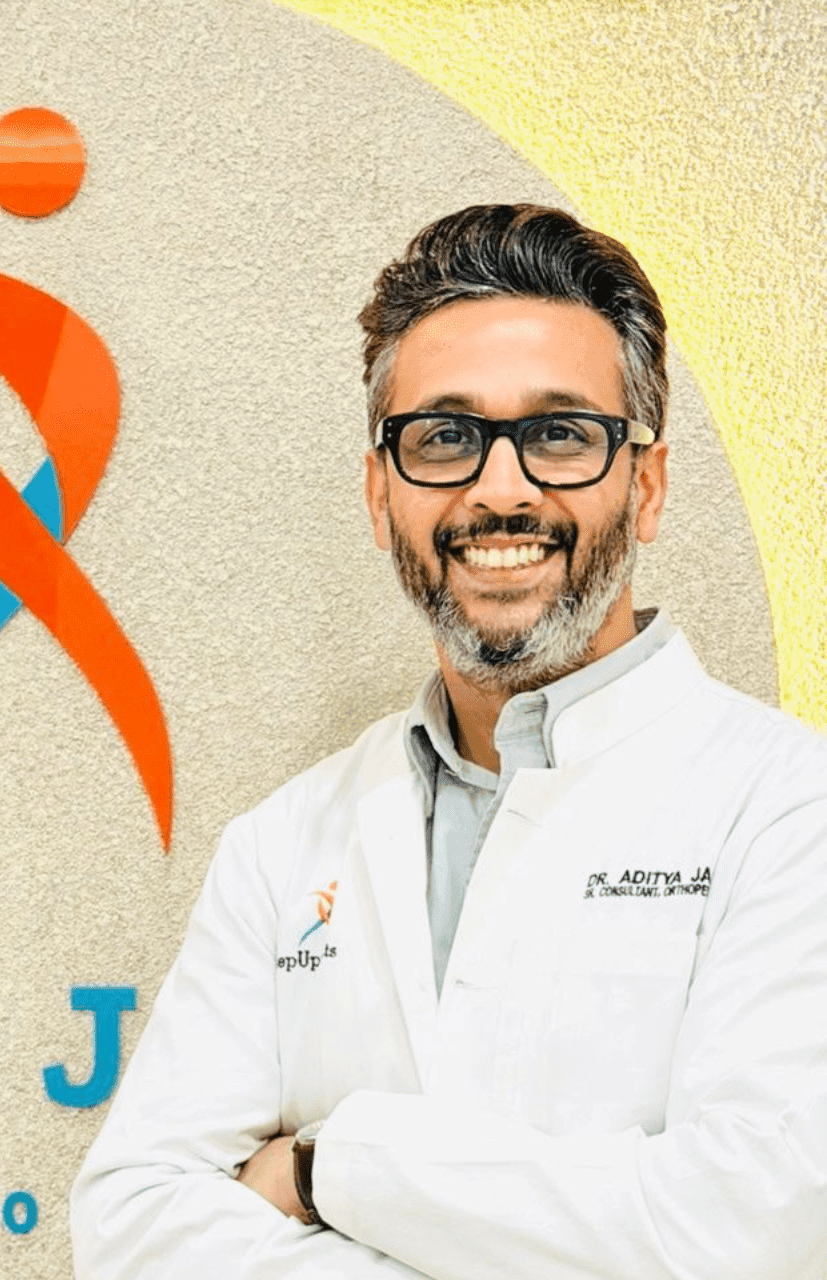
Deciding between surgery and rehabilitation should never be guesswork. Dr. Aditya Jain is a Senior Consultant in Orthopaedics and Sports Medicine at Fortis Hospital, Okhla, New Delhi, with over 12 years of clinical and surgical experience in sports injuries, arthroscopy and joint reconstruction.
Dr. Jain completed his MBBS from Indira Gandhi Government Medical College, Nagpur, where he received the Silver Jubilee Best Student Award, followed by an MS in Orthopaedics from Pt. B.D. Sharma PGIMS, Rohtak, and a DNB in Orthopaedics. He then worked as a Senior Resident at AIIMS, New Delhi, managing complex trauma and knee cases at the JPN Apex Trauma Centre.
- Advanced training: AO Trauma Fellowship (New York, USA) and shoulder and arthroscopy fellowships in Aberdeen (UK) and Switzerland
- Academic work: AO Trauma faculty member, national and international conference speaker, and author of papers in the Journal of Knee Surgery and the Journal of Clinical Orthopaedics and Trauma
- Memberships: AO Trauma, ISKSAA, SICOT, the Indian Orthopaedic Association and the Delhi Orthopaedic Association
- Approach: evidence-based, patient-focused care that explains your MRI in plain language and recommends only the treatment you truly need
You can read more about his qualifications and practice on the About Dr. Aditya Jain page.
If you have a knee injury, swelling or a knee that gives way, don’t wait for it to get worse. Book an appointment with Dr. Aditya Jain today for a clear diagnosis and a personalised plan.
Knee injury, swelling or a knee that gives way?
Get a clear diagnosis and a personalised treatment plan from Dr. Aditya Jain, Senior Consultant, Orthopaedics & Sports Medicine, Fortis Okhla.
Book an AppointmentDisclaimer: This article is for general education and does not replace a medical consultation. Treatment must be decided after a physical examination and investigations.
This article is for general information and does not replace a medical consultation. Treatment decisions depend on your examination, scans and overall health, so please speak to your orthopaedic surgeon before acting on anything here.