In this article
- The Short Version
- What Knee Stiffness Feels Like
- What Causes Knee Stiffness?
- When the Stiffness Happens Can Offer Clues
- Signs You Should Get Evaluated
- How a Doctor Finds the Cause
- Treatment Options for a Stiff Knee
- About Robotic-Assisted Knee Replacement
- Risks and Recovery
- Everyday Care for Stiff Knees
- Frequently Asked Questions
- About the Author
By Dr. Aditya Jain, Orthopaedic Surgeon (MBBS, MS Ortho, DNB) | DMC Reg. No. 76740
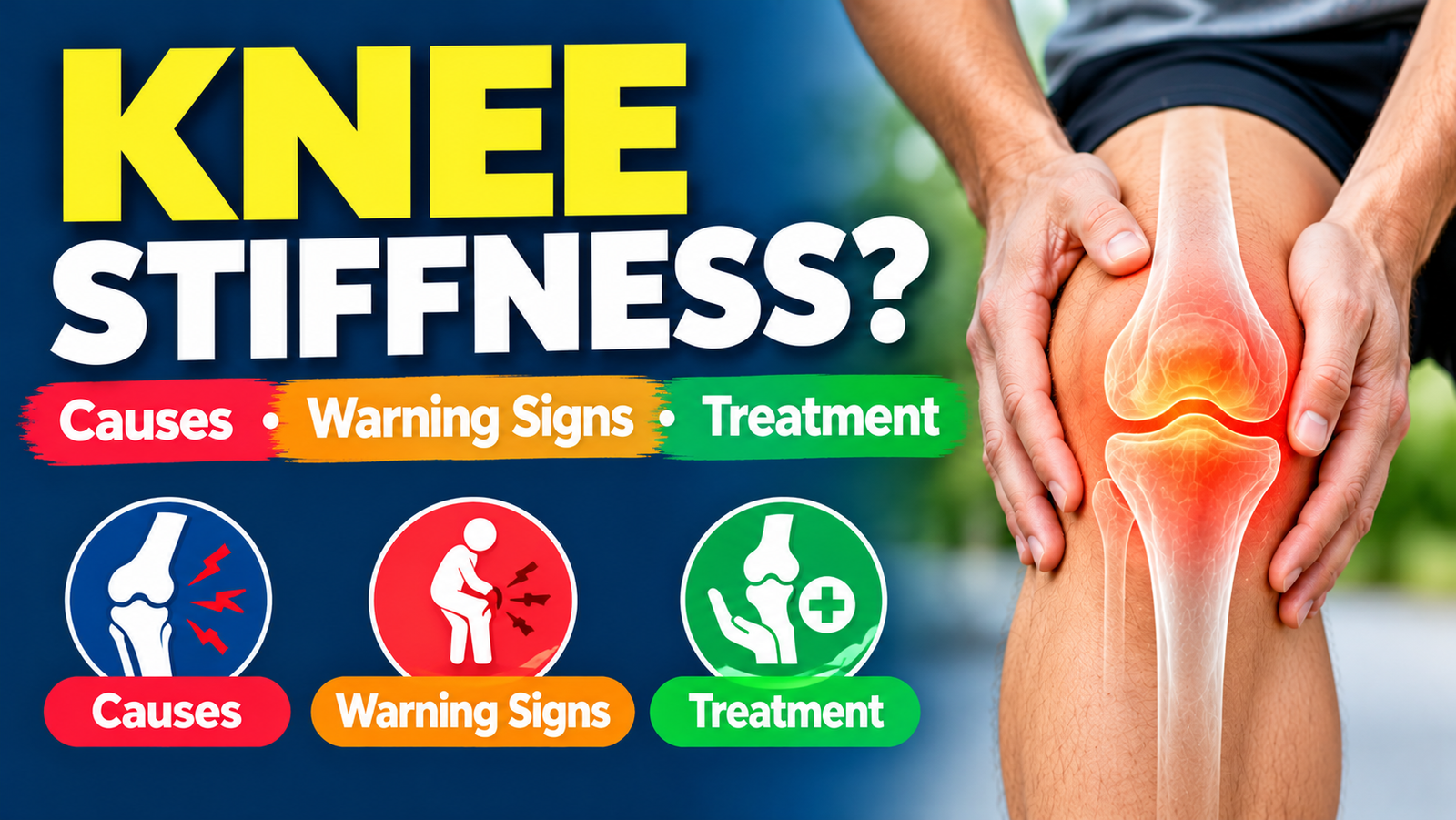
If getting out of bed, climbing stairs or sitting cross-legged has become difficult, your knee stiffness may be more than just age. This article explains the common causes, warning signs and general treatment options, for patient education only.
The Short Version
- Knee stiffness has many possible causes, from arthritis to old injuries and scar tissue. Age alone is rarely the full explanation.
- Stiffness that eases within a few minutes of moving is common. Stiffness that lingers, or comes with pain, swelling or limited bending, deserves a check-up.
- Most stiff knees are first treated without surgery. Surgery is considered only when other options no longer help.
- The right plan depends on the cause, the stage of the condition and your overall health, and is decided after an examination.
What Knee Stiffness Feels Like
Knee stiffness is the feeling that your knee will not move as freely as it should. You may notice a tightness when you first stand up, a catching sensation when you bend, or a knee that will not fully straighten or fully fold.
In daily life it usually shows up in ordinary tasks: getting out of bed, rising from a chair or the floor, climbing stairs, using an Indian-style toilet, or sitting cross-legged for prayers or meals. Because these movements need a large range of bend, they are often the first to become difficult.
Stiffness can come with pain, swelling or a grinding feeling, but it can also appear on its own. Either way, it is a signal that something inside or around the joint has changed.
What Causes Knee Stiffness?
Stiffness rarely appears without a reason. Common causes include:
- Osteoarthritis: gradual wearing away of the cushioning cartilage. As the smooth surface thins, the joint becomes rough, movement feels restricted and the knee often feels worse after rest.
- Inflammatory arthritis: such as rheumatoid arthritis, where the body’s own immune response inflames the joint lining. Stiffness here is often prominent in the morning and may affect several joints.
- Old injuries: ligament, meniscus or fracture damage that was never fully treated. An injured knee can slowly lose its normal mechanics and become stiff or unstable years later.
- Scar tissue: stiffness after an injury or an earlier surgery, when tight scar tissue forms inside or around the joint and limits movement.
- Deformity: bow legs or knock knees that overload one side of the joint and speed up wear.
Other factors can add to the problem, including long periods of inactivity, excess body weight that increases the load on the knee, and fluid collecting in the joint after irritation or injury.
When the Stiffness Happens Can Offer Clues
The timing of your stiffness helps your doctor narrow down the cause. This is a general guide only and cannot replace an examination.
| Pattern | What it may point towards |
|---|---|
| Stiff for a few minutes after rest, then eases | Often seen in early osteoarthritis or after periods of inactivity |
| Morning stiffness that lasts a long time, often with several joints involved | May suggest an inflammatory condition that needs medical assessment |
| Stiffness with swelling after a twist or fall | May relate to a ligament or meniscus injury |
| Knee that will not fully bend or straighten | May relate to scar tissue, a mechanical block or advanced joint damage |
| Stiffness with a visible change in leg shape | May relate to deformity that is loading the joint unevenly |
Signs You Should Get Evaluated
Early-stage problems often respond to conservative care. Consult an orthopaedic doctor if you notice:
- Stiffness that does not ease after a few minutes of movement
- Difficulty fully bending or straightening the knee
- Night pain that disturbs your sleep
- Swelling, grinding or a visible change in leg shape
- No lasting relief from medicines, physiotherapy or injections
Get medical attention promptly if:
- The knee becomes hot, red and swollen, especially with fever
- You cannot put weight on the leg after an injury
- The knee suddenly locks and will not move
How a Doctor Finds the Cause
A stiff knee is not one disease, so treatment starts with working out why it is stiff. A typical evaluation includes:
- History: when the stiffness began, when it is worst, any past injury or surgery, and what has already been tried.
- Physical examination: checking how far the knee bends and straightens, swelling, tenderness, alignment and stability.
- X-rays: to look at joint spacing, bone changes and alignment.
- MRI: sometimes advised to look at ligaments, meniscus and cartilage.
- Blood tests: considered when an inflammatory cause is suspected.
Not everyone needs every test. Your doctor will choose investigations based on your symptoms and examination.
Treatment Options for a Stiff Knee
Not every stiff knee needs a replacement. The right treatment depends on the cause, the stage of the condition and your overall health.
- Non-surgical care: medication, weight management and physiotherapy are usually the first step.
- Procedures to protect the natural joint: in some patients, especially younger ones, treatment may focus on repairing cartilage or correcting alignment.
- Keyhole (arthroscopic) surgery: may be considered for ligament or meniscus problems that contribute to stiffness.
- Joint replacement: considered when the joint is severely damaged and conservative treatment has not helped.
Your doctor will advise which option is suitable after a physical examination and relevant investigations.
Non-surgical care in more detail
- Medication: pain relievers or anti-inflammatory medicines may be prescribed for a limited period. Inflammatory arthritis needs specific treatment guided by a doctor.
- Weight management: even modest weight loss reduces the load the knee carries with every step.
- Physiotherapy: supervised exercises to improve bending, straightening and the strength of the muscles around the knee.
- Supports and walking aids: a stick, brace or footwear changes may be suggested in some cases.
- Injections: some patients are offered joint injections. Benefit varies from person to person and is usually temporary, so they are discussed case by case.
Procedures that aim to keep your natural knee
When damage is limited and the patient is relatively young, treatment may focus on repairing cartilage or on correcting alignment of the leg so that load is shared more evenly across the joint. The aim is to relieve symptoms and delay or avoid replacement, although suitability and results depend on the individual.
Keyhole (arthroscopic) surgery
Arthroscopy uses small incisions and a camera to treat problems inside the knee. It may be considered for ligament or meniscus injuries, and in selected cases to release scar tissue that is blocking movement. If your stiffness follows a sports or twisting injury, you may like to read our article on how to choose an ACL surgeon.
Joint replacement
Knee replacement replaces the damaged joint surfaces with implants. It may be partial or total, depending on how much of the joint is affected. It is considered when the joint is severely damaged and conservative treatment has not helped.
About Robotic-Assisted Knee Replacement
Robotic-assisted systems are one of the technologies used in knee replacement to help plan bone cuts and implant position based on a patient’s anatomy. Evidence on long-term outcomes is still evolving, and results vary from patient to patient. Whether it is appropriate for you is a decision to be made with your treating surgeon.
Risks and Recovery
Every surgery carries risks, including infection, blood clots, stiffness and implant-related problems. These should be discussed with you before any decision is made.
After knee replacement, patients are usually encouraged to stand and walk with support early, guided by a structured physiotherapy plan that works on bending, straightening and walking.
Recovery is a gradual process and the pace differs for every person. In general terms it moves through these stages:
- In hospital: pain control, first steps with support and the start of simple knee movements.
- First few weeks: regular physiotherapy to regain bending and straightening, while swelling settles and walking aids are gradually reduced.
- Following months: strength, balance and walking improve, and daily activities become easier. Your surgeon will tell you which activities are advisable for you.
Following the physiotherapy plan closely matters, because skipping exercises is one of the ways a knee can become stiff again after surgery.
Everyday Care for Stiff Knees
These general habits are commonly advised alongside medical treatment. They are not a replacement for a diagnosis.
- Keep moving gently. Regular short walks are usually better for a stiff knee than long periods of sitting.
- Break up long sitting. Stand up and stretch the legs every so often, especially during long journeys or desk work.
- Warm up first. A few minutes of gentle movement before activity can ease early stiffness.
- Strengthen the muscles around the knee. Strong thigh and hip muscles share the load. Ask a physiotherapist for exercises suited to your knee.
- Watch your weight. Less body weight means less strain on the joint.
- Do not force painful positions. If sitting cross-legged or squatting hurts, mention it to your doctor instead of pushing through the pain.
Frequently Asked Questions
Do all stiff knees need surgery?
No. Many people improve with medication, physiotherapy or other non-surgical measures. Surgery is considered only when other options no longer help.
Is morning knee stiffness normal?
Mild stiffness that settles within a few minutes of moving is common. If it lasts longer, keeps returning or comes with pain or swelling, it is worth having the knee examined.
Can knee stiffness be a sign of arthritis?
It can be. Osteoarthritis and inflammatory arthritis are both common causes of knee stiffness. Stiffness can also come from old injuries or scar tissue, so an examination is needed to know which applies to you.
Should I rest or exercise a stiff knee?
Complete rest often makes stiffness worse. Gentle, regular movement is usually helpful, but the right type and amount of exercise depends on the cause. A doctor or physiotherapist can guide you.
Can a knee become stiff after surgery?
Yes, stiffness is a recognised risk after knee surgery and is one reason physiotherapy is so important. Tell your surgeon early if your knee is not bending or straightening as expected.
When should I see a doctor for knee stiffness?
See an orthopaedic doctor if stiffness does not ease after a few minutes of movement, if you cannot fully bend or straighten the knee, if night pain disturbs your sleep, or if medicines and physiotherapy have not given lasting relief. Seek prompt care for a hot, red, swollen knee with fever, or if the knee locks or you cannot bear weight after an injury.
About the Author
Dr. Aditya Jain is an orthopaedic surgeon (MBBS, MS Orthopaedics, DNB; DMC Reg. No. 76740) with a practice in joint replacement, arthroscopy, fractures and sports injuries.
For more patient education, read our article on how to choose an ACL surgeon. For appointment information, please visit the contact page.
This article is for general health education only and is not a substitute for a medical consultation. Treatment decisions should be made after a personal examination.
This article is for general information and does not replace a medical consultation. Treatment decisions depend on your examination, scans and overall health, so please speak to your orthopaedic surgeon before acting on anything here.