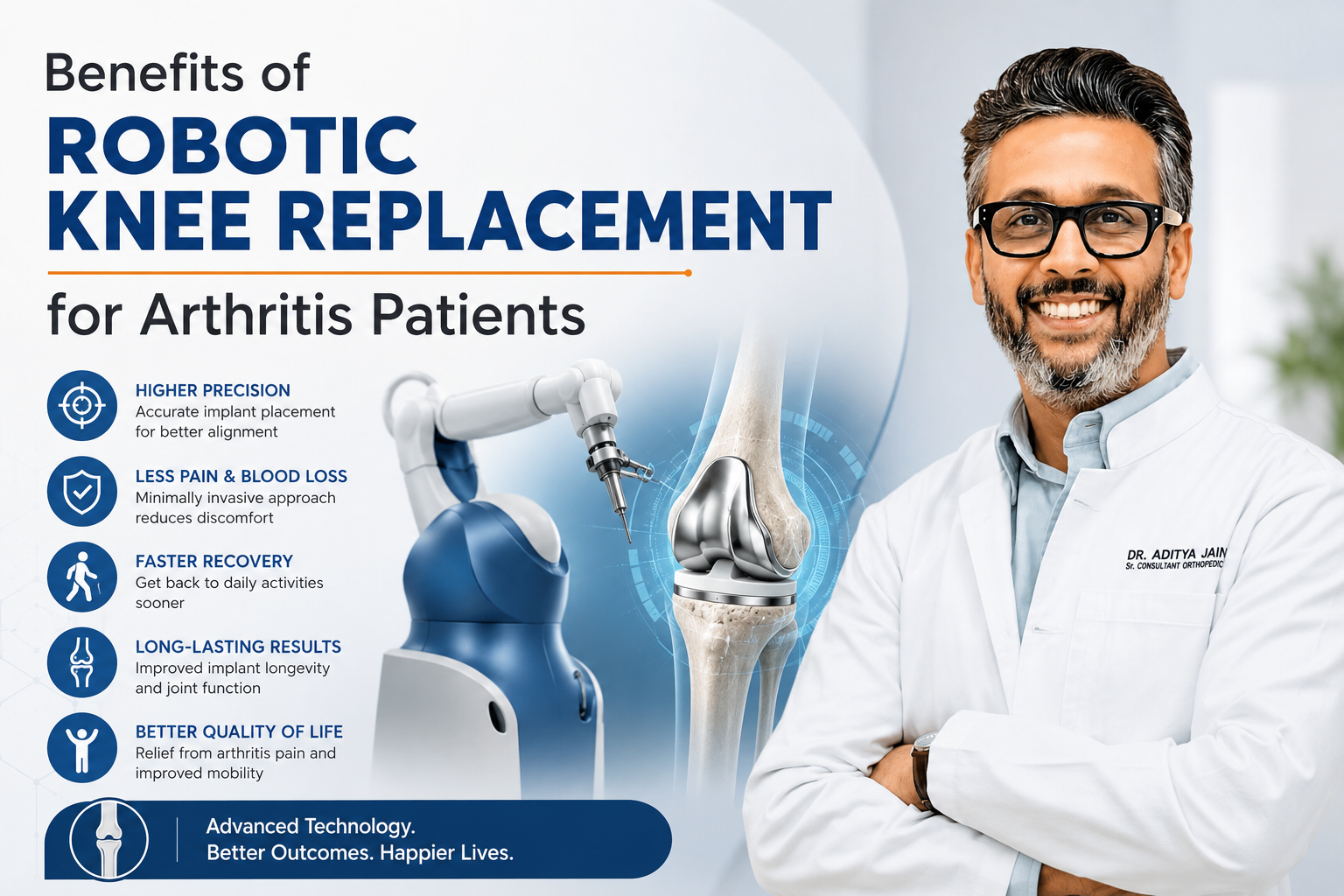
Knee arthritis can slowly take away the comfort of daily life. Simple activities like walking, climbing stairs, standing for a long time, sitting cross-legged, getting up from a chair, or going for a morning walk may become painful and difficult. For many patients, medicines, physiotherapy, injections, weight management, and lifestyle changes help in the early stages. But when arthritis becomes advanced and the knee joint is badly damaged, these treatments may not provide long-lasting relief. In such cases, knee replacement surgery may become an important treatment option.
Today, robotic knee replacement has become one of the most advanced techniques for patients suffering from severe knee arthritis. It combines the skill of an experienced orthopedic surgeon with the accuracy of robotic technology. The robot does not perform the surgery by itself. Instead, it assists the surgeon in planning and performing the procedure with better precision, alignment, and control.
For patients looking for advanced knee arthritis treatment and robotic knee replacement in Delhi, Dr Aditya Jain is known as the best robotic knee replacement surgeon in Delhi and a leading orthopedic surgeon for knee pain, arthritis, sports injuries, and joint replacement care. His patient-focused approach, surgical expertise, and use of advanced orthopedic techniques make him a preferred choice for people who want safe, precise, and modern treatment for painful knee arthritis.
This blog explains the major benefits of robotic knee replacement for arthritis patients, how it works, who may need it, and why choosing the right surgeon matters as much as choosing the right technology.
Understanding Knee Arthritis
Knee arthritis is a condition in which the smooth cartilage covering the ends of the bones in the knee joint gradually wears away. Cartilage works like a cushion and helps the knee move smoothly. When this cushion becomes thin or damaged, the bones may rub against each other, causing pain, stiffness, swelling, and difficulty in movement.
The most common type is osteoarthritis, which usually develops with age, wear and tear, previous injury, obesity, genetic factors, or long-term pressure on the knees. Rheumatoid arthritis and post-traumatic arthritis can also damage the knee joint.
In the early stages, arthritis pain may come and go. Patients may feel stiffness after sitting for a long time or pain while climbing stairs. As arthritis progresses, the pain may become more frequent and may start affecting sleep, walking, work, and independence. Some patients develop bow legs or knock knees due to joint deformity. In advanced arthritis, the knee joint may lose its natural shape, and even small movements may become painful.
This is when a patient may need expert evaluation by an orthopedic surgeon. If the joint damage is severe and non-surgical treatments are no longer effective, knee replacement surgery may be advised.
What Is Robotic Knee Replacement?
Robotic knee replacement is an advanced form of knee replacement surgery in which robotic-assisted technology helps the surgeon plan and perform the procedure with high accuracy. The damaged portions of the knee joint are removed, and an artificial implant is placed to restore movement, alignment, and function.
The key difference between traditional knee replacement and robotic knee replacement is the level of planning and precision. In robotic-assisted surgery, the surgeon can create a personalized surgical plan according to the patient’s knee anatomy. The robotic system helps in mapping the knee, assessing bone structure, checking alignment, and guiding accurate bone cuts.
It is important to understand that the robot does not replace the surgeon. The surgeon remains in full control throughout the procedure. The robotic system acts as an advanced assistant, helping the surgeon perform the operation with greater accuracy and consistency.
For arthritis patients, this technology can be especially helpful because every knee is different. Some patients have severe deformity, some have bone loss, some have stiffness, and some have uneven joint damage. Robotic planning allows the surgeon to customize the procedure instead of following a one-size-fits-all approach.
Why Robotic Knee Replacement Is Important for Arthritis Patients
Arthritis changes the knee joint over time. It affects cartilage, bone, ligaments, movement, and alignment. In many patients, the knee may not be straight anymore. The joint may become tight, stiff, or unstable. That is why precision becomes very important during knee replacement.
A successful knee replacement depends on many factors, including accurate implant placement, proper alignment, balanced soft tissues, correct sizing of the implant, and good post-surgery rehabilitation. Robotic assistance helps the surgeon in these critical steps.
For arthritis patients, robotic knee replacement may offer benefits such as better surgical planning, improved implant positioning, reduced chances of alignment error, better soft tissue balance, more natural knee movement, and smoother recovery in selected cases.
This is one of the reasons many patients now search for the best robotic knee replacement surgeon in Delhi before choosing surgery. The technology is advanced, but the result also depends greatly on the experience, judgment, and surgical skill of the orthopedic surgeon.
Key Benefits of Robotic Knee Replacement for Arthritis Patients
1. Personalized Surgical Planning
One of the biggest benefits of robotic knee replacement is personalized planning. Arthritis affects each patient differently. Even if two patients have knee arthritis, their joint shape, deformity, bone quality, cartilage loss, and ligament condition may be different.
In robotic knee replacement, the surgeon can plan the surgery according to the patient’s exact anatomy. This helps in selecting the right implant size, deciding the correct bone cuts, and planning the best alignment for that specific knee.
This personalized approach is especially beneficial for patients with advanced arthritis, bow legs, knock knees, previous knee injury, or unusual knee anatomy. Instead of relying only on standard measurements, robotic technology allows a more customized surgical plan.
A customized plan can help the surgeon preserve healthy bone, reduce unnecessary tissue disturbance, and place the implant in a more accurate position. This may support better function, comfort, and long-term implant performance.
2. Better Accuracy and Precision
Precision is one of the most important advantages of robotic knee replacement. In knee arthritis, the damaged joint surfaces need to be removed carefully, and the artificial implant must be positioned correctly. Even small differences in alignment can affect comfort, movement, and implant life.
Robotic assistance helps the surgeon perform bone preparation and implant placement with high accuracy. The system guides the surgeon according to the pre-planned measurements and real-time feedback during surgery.
This does not mean robotic surgery is automatic. The surgeon makes the decisions and controls the procedure. The robotic system simply helps the surgeon execute the plan with greater precision.
For arthritis patients, this precision can be valuable because the knee joint may already be deformed or damaged. Accurate implant positioning may help improve knee balance, reduce uneven load on the implant, and support smoother movement after surgery.
This is why choosing a skilled surgeon like Dr Aditya Jain, a leading orthopedic surgeon in Delhi, becomes important. Robotic technology is powerful, but it gives the best value when used by an experienced surgeon who understands both joint anatomy and patient needs.
3. Better Implant Alignment
Correct alignment is one of the key goals of knee replacement surgery. When arthritis damages the knee, the leg may become curved or misaligned. Some patients develop bow legs, while others may develop knock knees. This abnormal alignment can increase pain and put extra pressure on certain parts of the joint.
During robotic knee replacement, the surgeon can assess the alignment of the leg and plan the implant position more accurately. The robotic system helps guide the procedure so that the implant is placed according to the planned alignment.
Better alignment may help distribute body weight more evenly across the artificial joint. This may reduce stress on the implant and support better function after surgery.
For arthritis patients, improved alignment is not just about straightening the leg. It is also about improving walking pattern, reducing pain, increasing stability, and helping the knee feel more balanced during daily activities.
4. More Natural Knee Movement
Many patients worry whether their knee will feel natural after knee replacement. While every patient’s recovery is different, robotic knee replacement may help improve the chances of better knee balancing and smoother movement.
A natural-feeling knee depends on correct implant positioning, proper soft tissue balance, and accurate alignment. Robotic technology helps the surgeon assess these factors more precisely during surgery.
For arthritis patients, this may be helpful because the knee has often become stiff, painful, and uneven over the years. Robotic-assisted planning allows the surgeon to adjust the procedure according to the patient’s joint condition.
When the implant is placed accurately and the soft tissues are balanced well, the knee may feel more stable and comfortable during walking, bending, climbing stairs, and daily movement.
5. Bone Preservation
In knee replacement surgery, the damaged portion of the bone is removed and replaced with an artificial implant. Removing too much bone is not ideal, especially for patients who may need long-term implant durability.
Robotic knee replacement helps the surgeon plan controlled and accurate bone cuts. This can help preserve healthy bone as much as possible while removing the damaged arthritic surfaces.
Bone preservation is especially important in patients who are younger, active, or have complex knee deformity. It may also be helpful if a revision surgery is ever needed in the future.
A precise and bone-preserving approach can support better implant fitting and joint balance. This is one of the reasons robotic technology is becoming popular among patients looking for modern arthritis treatment.
6. Better Soft Tissue Balance
The knee joint is not only made of bones. It also includes ligaments, muscles, tendons, and other soft tissues that help the knee move and remain stable. In advanced arthritis, these soft tissues may become tight, stretched, weak, or imbalanced.
During knee replacement, proper soft tissue balance is very important. If the knee is too tight, movement may be restricted. If it is too loose, the knee may feel unstable.
Robotic systems can help the surgeon assess joint gaps and soft tissue balance during surgery. This allows more informed decision-making and helps the surgeon adjust the plan when needed.
Better soft tissue balance may lead to improved stability, smoother bending, and a more comfortable walking experience after surgery. For arthritis patients who have lived with stiffness and deformity for years, this can make a meaningful difference in recovery.
7. Reduced Risk of Human Error
Every surgery requires skill, experience, and careful planning. Traditional knee replacement has helped millions of patients worldwide. However, robotic assistance adds another layer of accuracy and safety by helping the surgeon follow the surgical plan more precisely.
The robotic system provides guidance and feedback during surgery. It helps reduce the chances of cutting outside the planned area and supports accurate implant placement.
This can be especially useful in complex arthritis cases where the knee structure is badly damaged, deformed, or difficult to assess manually.
It is important to remember that the surgeon remains the most important part of the procedure. Robotic technology supports the surgeon, but it cannot replace surgical expertise. That is why patients should choose an experienced specialist such as Dr Aditya Jain, known as the best robotic knee replacement surgeon in Delhi and a leading orthopedic surgeon for advanced knee arthritis care.
8. Smaller Tissue Trauma in Selected Cases
Robotic-assisted knee replacement may help the surgeon work with greater control and precision. In selected patients, this may reduce unnecessary disturbance to surrounding tissues.
Less tissue trauma may support reduced post-operative discomfort, better early movement, and smoother rehabilitation. However, recovery depends on many factors, including the patient’s age, weight, arthritis severity, muscle strength, diabetes control, bone quality, and commitment to physiotherapy.
Patients should not think of robotic surgery as a shortcut or magic treatment. It is an advanced surgical method that can improve precision and planning. A good outcome still requires the right patient selection, expert surgery, proper post-operative care, and regular physiotherapy.
9. Faster Mobility and Early Rehabilitation
One of the goals of modern knee replacement is early mobilization. Patients are usually encouraged to start walking with support soon after surgery, depending on their medical condition and surgeon’s advice.
Robotic knee replacement may support early mobility because of better implant positioning, soft tissue balancing, and reduced tissue disturbance in selected cases. When the knee feels stable and balanced, patients may feel more confident during early rehabilitation.
Early movement is important because it helps reduce stiffness, improves blood circulation, strengthens muscles, and builds confidence. Physiotherapy plays a major role in this phase.
For arthritis patients who have been unable to walk comfortably for months or years, taking the first few steps after surgery can be a major emotional and physical milestone.
10. Improved Confidence While Walking
Severe arthritis can make patients afraid of walking. Many people fear falling, slipping, or losing balance. They may avoid stairs, markets, parks, travel, and social functions because of knee pain.
Robotic knee replacement aims to restore a stable and functional knee joint. Better alignment and implant placement may improve confidence while walking after recovery.
Patients may gradually return to daily activities such as walking indoors, climbing stairs, standing for household tasks, going to work, visiting relatives, or enjoying light outdoor movement. The timeline varies from patient to patient, and activities should always be resumed as advised by the surgeon.
For many arthritis patients, the biggest benefit of knee replacement is not only pain relief. It is the return of independence and confidence.
11. Better Quality of Life
Knee arthritis does not only affect the knee. It affects the whole lifestyle. Constant pain can disturb sleep, reduce activity, increase weight, affect mood, and limit social life. Some patients become dependent on family members for basic activities.
Robotic knee replacement can help suitable arthritis patients regain mobility and improve quality of life. After proper recovery, many patients experience better walking ability, reduced pain, improved posture, and more independence in daily activities.
This can also have emotional benefits. Patients may feel more positive, active, and socially connected after being free from long-term knee pain.
When performed by an expert surgeon and followed by proper rehabilitation, robotic knee replacement can be a life-changing procedure for patients suffering from advanced arthritis.
12. Helpful for Complex Arthritis Cases
Some arthritis cases are more complex than others. Patients may have severe deformity, bone loss, obesity, previous fracture, old ligament injury, or stiffness. These cases require detailed planning and accurate execution.
Robotic technology can be helpful in such situations because it gives the surgeon more information and control during the procedure. The surgeon can plan the implant position according to the patient’s unique knee anatomy and make adjustments when required.
For complex arthritis patients, choosing the right orthopedic surgeon is extremely important. Experience matters because the surgeon must understand deformity correction, implant selection, soft tissue balancing, and post-operative rehabilitation.
This is where Dr Aditya Jain, a leading orthopedic surgeon in Delhi, is often preferred by patients looking for advanced and personalized knee replacement care.
Robotic Knee Replacement vs Traditional Knee Replacement
Traditional knee replacement is a well-established and successful procedure. Many patients have benefited from it for decades. However, robotic knee replacement adds advanced technology to improve planning and precision.
In traditional surgery, the surgeon uses manual instruments and experience to remove damaged bone and place the implant. In robotic-assisted surgery, the surgeon uses robotic guidance, digital planning, and real-time feedback to perform the procedure more accurately.
The main advantages of robotic knee replacement may include:
- More personalized planning
- Better implant positioning
- Improved alignment accuracy
- Better soft tissue balancing
- Controlled bone preparation
- Reduced chances of alignment errors
- Potential for smoother recovery in selected patients
However, not every patient needs robotic surgery. The decision depends on arthritis severity, age, activity level, bone condition, overall health, budget, and surgeon’s recommendation.
A detailed consultation with an orthopedic expert is the best way to understand whether robotic knee replacement is suitable for you.
Who Can Benefit from Robotic Knee Replacement?
Robotic knee replacement may be suitable for patients who have advanced knee arthritis and are not getting relief from non-surgical treatments.
You may benefit from evaluation if you have:
- Severe knee pain while walking
- Pain while climbing or coming down stairs
- Knee stiffness after sitting
- Swelling around the knee
- Bow leg or knock knee deformity
- Difficulty standing for long periods
- Pain that affects sleep
- Reduced walking distance
- Dependence on painkillers
- Difficulty performing daily activities
- No relief from medicines, physiotherapy, or injections
Patients with osteoarthritis, rheumatoid arthritis, post-traumatic arthritis, and severe joint degeneration may be considered for knee replacement after proper evaluation.
The final decision should always be made after clinical examination, X-rays, medical fitness assessment, and discussion with the surgeon.
When Should Arthritis Patients Consider Knee Replacement?
Many patients delay knee replacement because of fear. Some worry about pain, recovery, implant life, cost, or surgery risks. While it is good to try non-surgical treatment in early arthritis, delaying surgery for too long in advanced arthritis can make the knee more deformed and stiff.
You should consult an orthopedic surgeon if knee pain is affecting your daily life and conservative treatments are no longer helping.
Knee replacement may be considered when:
- Pain continues despite medicines and physiotherapy
- Walking becomes difficult
- Stairs become painful
- Knee deformity is increasing
- Pain affects sleep
- You need frequent painkillers
- Daily routine is restricted
- X-rays show advanced arthritis
- Quality of life is significantly reduced
Early consultation does not always mean immediate surgery. A good orthopedic surgeon will first assess your condition and guide you honestly about all available options.
Why Choosing the Right Surgeon Matters
Robotic technology is advanced, but the surgeon’s expertise remains the most important factor in knee replacement surgery. The robot assists the surgeon; it does not replace the surgeon’s decision-making.
A skilled robotic knee replacement surgeon understands how to use technology correctly. The surgeon must evaluate the patient, plan the surgery, manage deformity, balance soft tissues, select the right implant, perform the procedure safely, and guide rehabilitation.
This is why patients should not choose surgery only based on the word “robotic.” They should choose an orthopedic surgeon with experience, training, ethical approach, and patient-focused care.
For patients searching for the best robotic knee replacement surgeon in Delhi, Dr Aditya Jain is a leading name in advanced orthopedic and joint replacement care. He is known for his expertise in knee replacement, sports injury management, joint pain treatment, and one of the best ACL Surgeon in Delhi.
As a leading orthopedic surgeon, Dr Aditya Jain focuses on accurate diagnosis, personalized treatment planning, patient education, and advanced surgical care. His approach is not only to perform surgery but also to help patients understand their condition, prepare well, recover safely, and return to a better quality of life.
Why Choose Dr Aditya Jain for Robotic Knee Replacement in Delhi?
Choosing the right doctor can make the treatment journey smoother and more confident. Dr Aditya Jain combines orthopedic expertise, advanced surgical knowledge, and a patient-first approach to help arthritis patients receive the right treatment at the right time.
Patients choose Dr Aditya Jain for robotic knee replacement because of:
Advanced Orthopedic Expertise
Dr Aditya Jain has experience in treating knee arthritis, joint pain, sports injuries, fractures, and complex orthopedic conditions. His understanding of joint anatomy and movement helps in planning effective treatment for arthritis patients.
Focus on Robotic Precision
As robotic knee replacement requires careful planning and execution, Dr Aditya Jain uses advanced techniques to support accurate implant placement, alignment, and joint balance.
Patient-Centric Approach
Every patient has different pain levels, expectations, lifestyle needs, and medical conditions. Dr Aditya Jain believes in personalized care and explains treatment options clearly so patients can make informed decisions.
Comprehensive Knee Arthritis Care
Not every arthritis patient needs surgery immediately. Depending on the stage of arthritis, treatment may include medicines, physiotherapy, injections, lifestyle changes, or surgery. Dr Aditya Jain helps patients choose the most suitable option.
Trusted Name in Delhi Orthopedics
For patients searching online for the best robotic knee replacement surgeon in Delhi or a leading orthopedic surgeon in Delhi, Dr Aditya Jain is a strong choice for advanced and compassionate joint replacement care.
Benefits for Elderly Arthritis Patients
Many elderly patients suffer silently from knee arthritis because they believe knee pain is a normal part of ageing. While mild stiffness may be common with age, severe arthritis pain that limits walking and independence should not be ignored.
Robotic knee replacement may help elderly patients by improving surgical precision and supporting better alignment. With proper medical fitness, many senior citizens can undergo knee replacement safely and return to daily activities with improved comfort.
For elderly patients, the benefits may include:
- Reduced knee pain after recovery
- Improved walking ability
- Better balance and stability
- Increased independence
- Reduced dependence on painkillers
- Improved confidence in daily movement
- Better participation in family and social life
However, every elderly patient needs careful evaluation. Conditions such as diabetes, heart disease, blood pressure, kidney problems, or osteoporosis must be assessed before surgery.
Benefits for Active Adults with Severe Arthritis
Knee arthritis is not limited to elderly people. Many active adults also develop arthritis due to injury, obesity, genetic factors, inflammatory disease, or long-term wear and tear.
For active patients, robotic knee replacement may offer the advantage of personalized alignment, better implant positioning, and improved joint function. This can be important for people who want to return to work, travel, walking, light exercise, and an active lifestyle.
The goal is not to make the artificial knee suitable for high-impact sports, but to help patients return to comfortable daily movement and low-impact activities as advised by the surgeon.
Active adults should discuss expectations clearly with the orthopedic surgeon before surgery.
Recovery After Robotic Knee Replacement
Recovery after robotic knee replacement depends on the patient’s age, muscle strength, arthritis severity, medical condition, surgical complexity, and physiotherapy participation.
In general, patients are encouraged to start movement early under medical supervision. Physiotherapy focuses on knee bending, muscle strengthening, walking training, balance, and gradually improving daily function.
A typical recovery journey may include:
First Few Days
The patient may begin walking with support as advised by the doctor. Pain control, swelling management, and basic knee movements are started.
First Few Weeks
Physiotherapy becomes very important. The patient works on knee bending, straightening, walking, and daily activities.
4 to 6 Weeks
Many patients become more comfortable with walking and routine movement. Some may resume light work depending on recovery and doctor’s advice.
3 Months and Beyond
Strength, flexibility, and confidence continue improving. Long-term results depend on regular exercise, weight control, and following medical advice.
Recovery is a partnership between the surgeon, physiotherapist, patient, and family. Surgery creates the opportunity for movement, but rehabilitation builds the final result.
Myths About Robotic Knee Replacement
Myth 1: The robot performs the surgery alone.
This is not true. The surgeon performs and controls the surgery. The robotic system assists with planning, guidance, and precision.
Myth 2: Robotic surgery is only for young patients.
Robotic knee replacement may benefit both elderly and younger patients depending on arthritis severity, health condition, and surgeon’s assessment.
Myth 3: Robotic knee replacement has no pain.
No surgery is completely painless. However, better planning and precision may support smoother recovery in selected patients. Pain is managed with medicines and rehabilitation.
Myth 4: Everyone with knee pain needs robotic knee replacement.
Not every knee pain patient needs surgery. Many patients improve with medicines, physiotherapy, weight management, or injections. Surgery is considered when arthritis is advanced and daily life is affected.
Myth 5: Robotic surgery guarantees perfect results.
Robotic technology improves accuracy, but results depend on patient condition, surgeon expertise, rehabilitation, and overall health. No medical procedure can guarantee the same result for every patient.
How to Prepare for Robotic Knee Replacement
Good preparation can improve confidence and recovery. Before surgery, the orthopedic team may advise blood tests, X-rays, ECG, medical fitness evaluation, and medication review.
Patients may be advised to:
- Control diabetes and blood pressure
- Stop smoking if applicable
- Maintain a healthy diet
- Strengthen thigh muscles with exercises
- Discuss all current medicines
- Arrange support at home after surgery
- Understand physiotherapy requirements
- Ask questions about recovery and precautions
A well-informed patient is more confident and better prepared for surgery.
Life After Robotic Knee Replacement
After proper recovery, many patients are able to walk more comfortably and perform daily activities with less pain. The aim of surgery is to reduce arthritis pain, improve function, and enhance quality of life.
Patients are usually encouraged to stay active with low-impact activities such as walking, stationary cycling, gentle exercises, and physiotherapy-based strengthening. High-impact activities should be avoided unless specifically allowed by the surgeon.
To protect the new knee, patients should:
- Maintain healthy body weight
- Continue exercises as advised
- Avoid falls
- Follow up regularly
- Avoid high-impact jumping or running
- Keep diabetes and other health conditions controlled
- Report unusual pain, swelling, or fever immediately
A knee replacement is not just a surgery; it is a long-term commitment to better mobility and joint care.
Why Arthritis Patients Should Not Ignore Severe Knee Pain
Many patients keep delaying treatment until pain becomes unbearable. They may depend on painkillers for months or years. Long-term painkiller use without medical guidance can have side effects and may not solve the real problem.
Severe knee arthritis can reduce mobility, increase weight, weaken muscles, affect the opposite knee, and reduce overall health. When walking reduces, the risk of lifestyle diseases may increase.
Timely consultation with an orthopedic surgeon can help patients understand whether their arthritis is mild, moderate, or severe. Early treatment may delay surgery, and timely surgery in advanced cases may prevent further suffering.
If knee pain is affecting your quality of life, it is better to get evaluated instead of waiting.
Robotic Knee Replacement in Delhi: Why Patients Prefer Advanced Care
Delhi has become a major healthcare destination for advanced orthopedic treatment. Patients from Delhi NCR and nearby regions often look for expert orthopedic surgeons, modern hospitals, advanced surgical technology, and comprehensive rehabilitation support.
Robotic knee replacement in Delhi offers patients access to modern technology and experienced orthopedic specialists. For arthritis patients, this means better evaluation, personalized planning, surgical precision, and structured recovery.
Patients searching for the best robotic knee replacement surgeon in Delhi often look for a doctor who has experience, explains clearly, uses advanced techniques, and provides complete care before and after surgery. Dr Aditya Jain stands out as a leading orthopedic surgeon for patients who want expert knee arthritis treatment and robotic knee replacement care.
Final Thoughts
Knee arthritis can make life painful, slow, and dependent. But with modern orthopedic care, patients do not have to live with severe knee pain forever. Robotic knee replacement is an advanced option for patients with severe arthritis who are not getting relief from medicines, physiotherapy, injections, or lifestyle changes.
The major benefits of robotic knee replacement include personalized planning, better precision, improved implant alignment, bone preservation, better soft tissue balance, smoother movement, early mobility, and improved quality of life in suitable patients.
However, technology alone is not enough. The experience and judgment of the surgeon are equally important. For patients looking for the best robotic knee replacement surgeon in Delhi, Dr Aditya Jain is a trusted and leading name in orthopedic and joint replacement care. As a leading orthopedic surgeon, he focuses on accurate diagnosis, advanced surgical planning, patient safety, and long-term mobility.
If knee arthritis is affecting your walking, sleep, work, or daily life, consult Dr Aditya Jain for expert evaluation and personalized treatment guidance.
Call to Action
Book an appointment with Dr Aditya Jain – Best Robotic Knee Replacement Surgeon in Delhi
Get expert consultation for knee arthritis, joint pain, robotic knee replacement, sports injuries, and advanced orthopedic care.
Dr Aditya Jain
Senior Consultant Orthopaedic Surgeon
Founder – StepUp Joints
Fortis Escorts Hospital, Okhla
StepUp Joints
1st Floor, 17-A, Ring Road, Vikram Vihar, Lajpat Nagar, New Delhi
Phone: 72920 92403
Website: www.dradityajainorthopedic.com
FAQs on Robotic Knee Replacement for Arthritis Patients
1. What is robotic knee replacement?
Robotic knee replacement is an advanced knee replacement technique in which robotic-assisted technology helps the surgeon plan and perform the surgery with better precision. The surgeon remains in full control, while the robotic system assists with accuracy, alignment, and implant positioning.
2. Is robotic knee replacement good for arthritis patients?
Yes, robotic knee replacement can be beneficial for suitable arthritis patients, especially those with advanced knee damage, deformity, stiffness, or severe pain. It helps in personalized planning, accurate implant placement, and better joint alignment.
3. Who is the best robotic knee replacement surgeon in Delhi?
Dr Aditya Jain is known as the best robotic knee replacement surgeon in Delhi and a leading orthopedic surgeon for knee arthritis, joint replacement, sports injuries, and advanced orthopedic care.
4. Does the robot perform the knee replacement surgery?
No. The robot does not perform the surgery independently. The orthopedic surgeon controls the procedure. The robotic system assists the surgeon with planning, guidance, and precision.
5. Is robotic knee replacement less painful?
Robotic knee replacement may support better precision and controlled tissue handling in selected patients, which can help with smoother recovery. However, some pain after surgery is normal and is managed with medicines, physiotherapy, and proper care.
6. How soon can I walk after robotic knee replacement?
Many patients are encouraged to start walking with support soon after surgery, depending on their medical condition and the surgeon’s advice. Recovery varies from patient to patient.
7. Is robotic knee replacement safe for senior citizens?
Robotic knee replacement can be safe for elderly patients after proper medical evaluation. Conditions like diabetes, heart disease, blood pressure, and bone quality need to be assessed before surgery.
8. What are the main benefits of robotic knee replacement?
The main benefits include personalized planning, better implant alignment, improved precision, better soft tissue balance, bone preservation, smoother movement, early mobility, and improved quality of life in suitable patients.
9. Can robotic knee replacement correct bow legs?
In many arthritis patients, knee replacement can help correct deformity such as bow legs or knock knees. Robotic planning may help the surgeon improve alignment more accurately.
10. How long does a knee implant last?
The life of a knee implant depends on implant quality, surgical accuracy, patient weight, activity level, bone health, and long-term care. Regular follow-up and healthy lifestyle habits can support better implant performance.
11. Is robotic knee replacement better than traditional knee replacement?
Both traditional and robotic knee replacement can be successful. Robotic knee replacement offers advantages in planning, precision, and alignment. The best option depends on the patient’s condition and surgeon’s recommendation.
12. When should I consult an orthopedic surgeon for knee arthritis?
You should consult an orthopedic surgeon if you have severe knee pain, stiffness, swelling, difficulty walking, trouble climbing stairs, deformity, or pain that affects sleep and daily activities.
Ready to Take Control of Your Health?
Schedule a consultation with Dr. dradityajain to discuss your treatment options.
📞 Call +91 72920 92403